
Paulus Potter's 'Orpheus and the Animals' (1650) as a Reflection of the 'Ideal' Republic
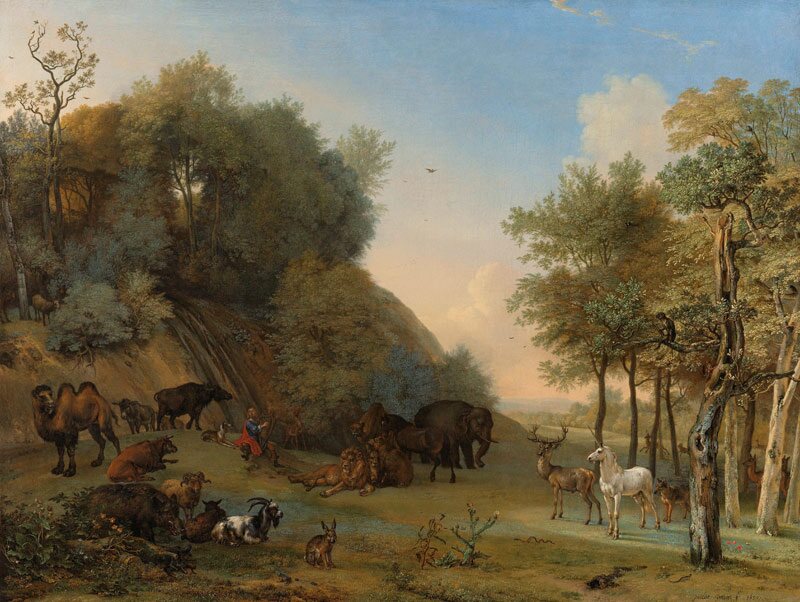
(Painting 1) Orpheus and the Animals (1650) – Paulus Potter, oil on canvas, 67 x 89 cm, photo via Rijksmuseum
Introduction
This paper centres on the painting 'Orpheus and the Animals' (1650) by Paulus Potter (1625-1654).1 The painting depicts a wooded scene in which animals gather around a figure in a bright red cloak. Given the painting's title, the person depicted must be the mythical singer Orpheus. In the foreground, a cow, goat, dog, and deer are depicted, among others, but also exotic animals such as lions, an elephant, a camel, and even a unicorn. In the 17th century, Orpheus was seen as a symbol of the power of art and music to create order, control passions, and establish harmony.2 In Potter's painting, the ideal of mutual harmony between predators and prey appears to be given visual form.
The painting can be understood within a broader, culturally eclectic context in which art, mythology, and nature are brought together into a single whole: a depiction in which harmony between man and animal is central. From this perspective, the question arises as to what extent Potter conveys a moral and/or social message with this painting. Can the peaceful gathering of diverse animal species be read as a metaphor for the ideal society?
To answer this question, this research adopts three approaches. Firstly, it analyses the visual elements Potter uses in the painting. The composition of 'Orpheus and the Animals' is then compared with a similar work by Potter entitled 'Shepherds with their Cattle' (1651).3 Subsequently, the iconographical meaning of 'Orpheus and the Animals' in the 17th century is examined and compared with that of another landscape painter of the period. Finally, the paper addresses the interpretation of the painting as an allegory for human society and the implicit moral and social message that can be recognised therein.
Paulus Potter and his Composition
Potter constructs the composition as a landscape that can be divided into three main compartments: a low, detailed foreground, a tranquil clearing, and a slowly brightening horizon. The repoussoir, in this case, is a mass of rocks and trees placed in the foreground to create depth and to further illuminate the scene in the centre of the composition.4 A contrast from dark to light can be seen in the composition. In this way, Potter directs the eye from the upper left to the bright horizon on the right. Along this route, the gaze passes important resting points such as Orpheus, the animals, and in particular the unicorn, which stands out for its colour. The composition forms a kind of asymmetrical balance, in which the mass on the left and the clearing on the right paradoxically seem to create stability.
Potter further reinforces the stable, harmonious image through the use of geometry.5 On the left is the mass containing Orpheus as a colour accent; on the right, a white unicorn as a light colour accent; and the open horizon in the background of the composition. Apart from its geometric function, the unicorn also has an allegorical meaning related to the senses. Through the presence of a unicorn, the rarest of mythical creatures, Orpheus's lyre-playing once again symbolises the unparalleled power to bring about harmonious and peaceful unity.6
The other way in which Potter softens tensions is by giving the animals specific postures. The predators in the composition, for instance, display signals of a non-aggressive state. The lions, for example, are lying stretched out with relaxed backs and their mouths closed. The prey animals, such as the cow, hare, and goat, are also lying or sitting in a resting position with their legs and necks outstretched. There is, therefore, a certain degree of harmony between predator and prey.
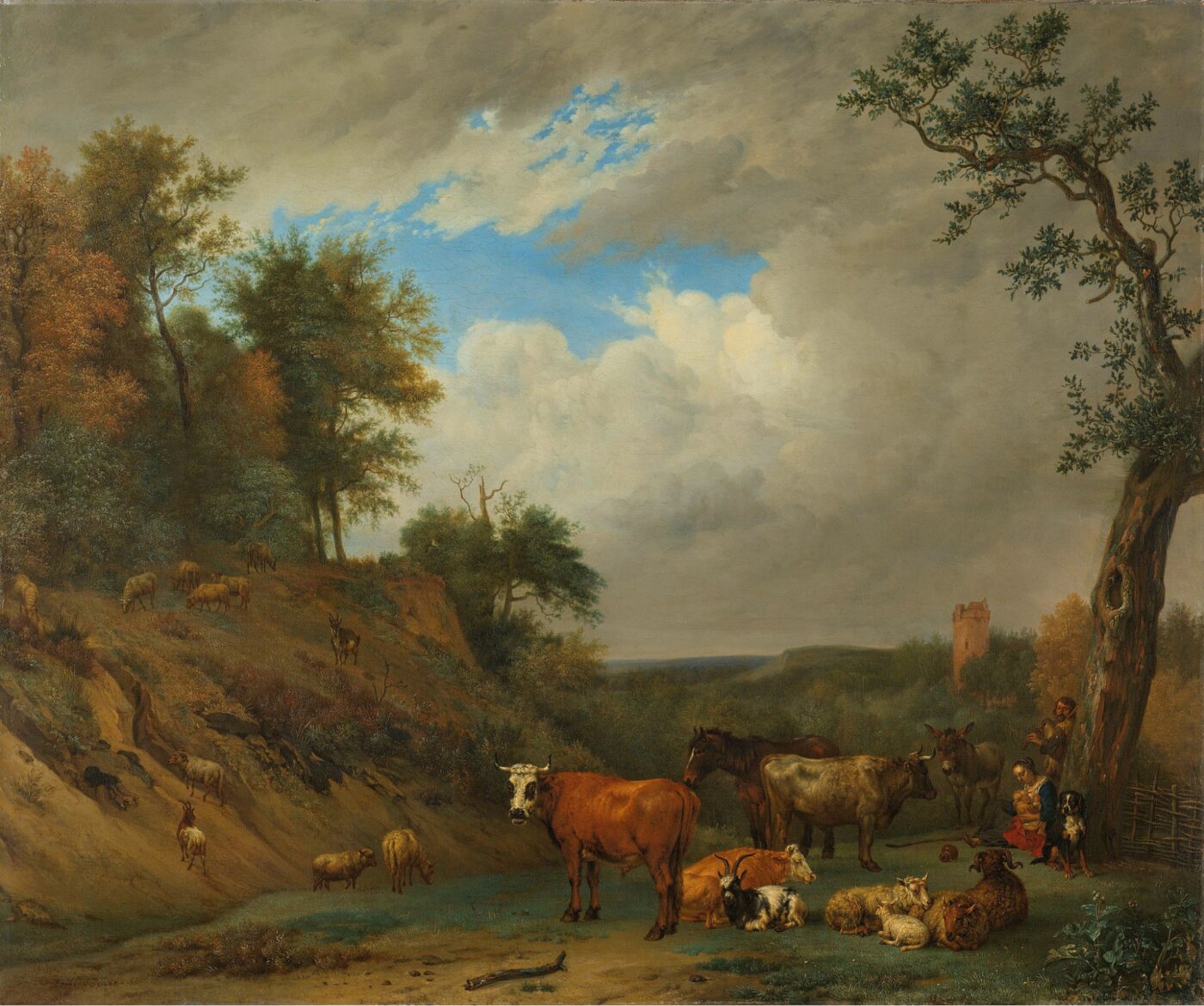
When we compare 'Orpheus and the Animals' (Painting 1) with another work by Potter, 'Shepherds with their Cattle' (Painting 2),7 a number of compositional similarities are noticeable. Both works feature a low horizon, through which the expansive landscape and sky create a calm, balanced atmosphere. In both paintings, the animals are distributed mainly horizontally across the foreground, leading to a central point of human figures amidst the mass of animals: the shepherds on the right in Painting 2, and Orpheus on the left in Painting 1. In terms of composition, both paintings seem to some extent typical of Potter's oeuvre. However, the exotic animals and mythological theme in Painting 1 are indeed exceptional within Potter's body of work,8 which indicates Potter's customary realism, but in this case connected to an exceptionally intellectual theme.
(Painting 2) Shepherds with their Cattle (1651) - Paulus Potter, oil on canvas, 82 x 97.5 cm, photo via Rijksmuseum
Iconography in 'Orpheus and the Animals'
On Potter's canvas (Painting 1), to the left of centre, a figure in a bright red cloak named Orpheus can be seen. This figure, surrounded by animals, occupies a central role in this context as a symbol of the power of music, art, and reason.9 The artwork's description indicates that Orpheus is playing a piece on his lyre.10 According to Greek mythology, Orpheus could soothe not only humans but also animals with his lyre.11 This is the scene that unfolds in the composition. During the Renaissance, this myth was rediscovered as a metaphor for the creative power of art and its ability to transform chaos into harmony.12 Orpheus is not heroically magnified, but is modestly present in the composition, seated in a landscape surrounded by lions, deer, cows, and even an elephant, among others. These are animals that are normally enemies, but coexist peacefully on the canvas. The composition testifies to the power Orpheus had with his music to bring order and balance to nature.
In 1627, more than 20 years earlier, Roelandt Savery (1576-1639) painted a similar animal piece entitled 'Orpheus Charming the Animals with his Music' (Painting 3).13 In his composition, Orpheus is also the peaceful central figure who brings diverse species of animals together in harmony through his lyre-playing. Jan Brueghel the Elder (1568-1625) and Savery were the first painters to specialise in depicting exotic animals at the beginning of the 17th century.14 The first paintings of exotic animals arose from religious and mythological subjects, of which Orpheus charming the animals with his music was a core theme.15 It is a genre that Potter would also join some years later with the creation of his 'Orpheus and the Animals'.
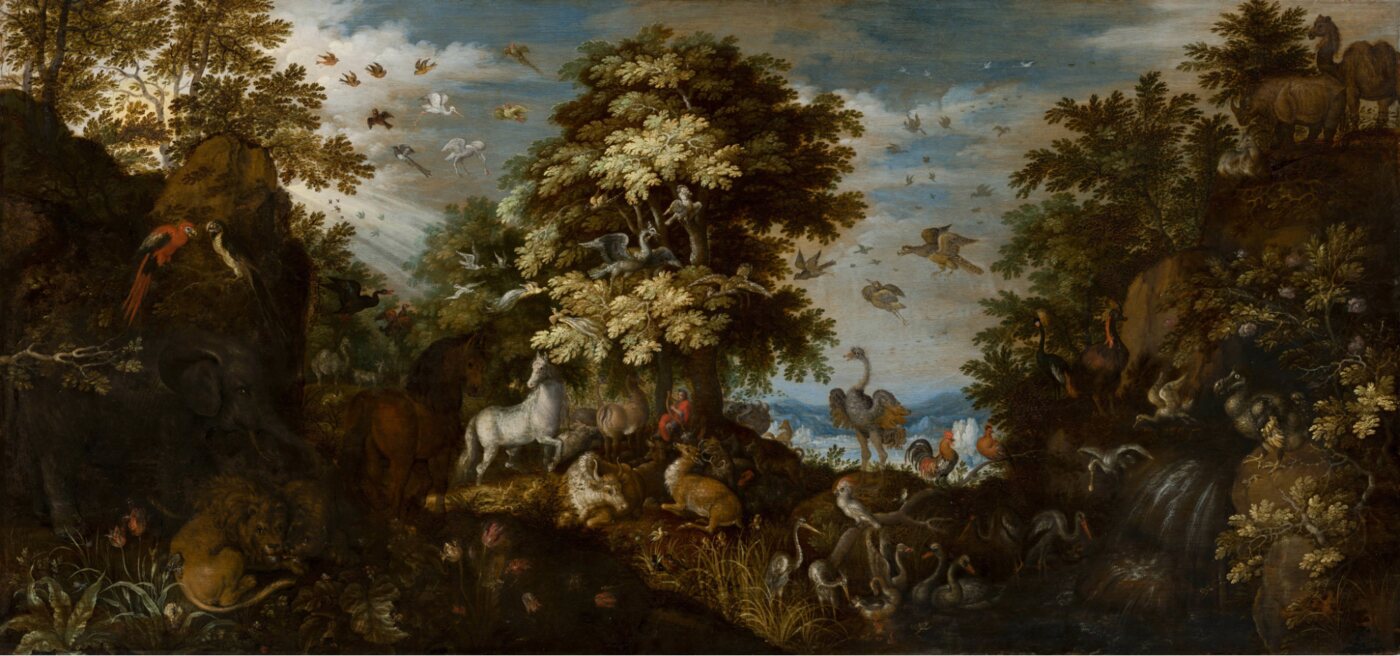
(Painting 3) Orpheus Charming the Animals with his Music (1627) - Roelandt Savery, oil on panel, 62 x 131.5 cm, photo via Mauritshuis
What distinguishes Potter's work from Savery's painting, however, is its naturalistic precision. Whereas in Savery's painting the animals are often rendered as exotic, decorative, and with less focus on composition, Potter's painting seems more to arrange 'reality' into a moral lesson. With this painting, Potter consciously deviates from the existing iconographical tradition. By connecting the classical theme with his specialisation in animal pieces, he positions himself within a paragone, or artistic competition, between mythological and naturalistic painting. Potter makes a strategic move by showing that, as an animal painter, he could also engage with intellectual themes. Simultaneously, Potter's painting thus testifies to his artistic ambition.
Peaceful Coexistence as an Allegory for Human Society
Landscape painting was considered, among other things, a form of moral education, a way to impart a certain message to the viewer.16 When we contextualise Potter's work within the zeitgeist of the Dutch Republic around 1650, various social significations emerge. Consider, for example, the humanist perspective, in which Orpheus in the painting not only tames the animals but also symbolises human passions. Orpheus embodies the self-control necessary for an orderly society.17 In line with Enenkel & Smith, who emphasise that 17th-century art often contains moralising messages, these compositions can be read as an allegory for social harmony.18 The peaceful coexistence of predators and prey reflects the ideal of virtue and peaceful community. Art and culture are presented here as means to tame the 'animal' within man. Through the depiction of both exotic and native animal species, this peaceful coexistence is linked to international societies. In this way, the work reflects the ideals of an international community in which different cultures can coexist in balance.
Around the time the painting was created, the Dutch Republic was in a period of political transition and recovery. The Eighty Years' War had just ended with the Peace of Münster in 1648, and the death of William II in 1650 marked the beginning of the first stadtholderless period. Potter's composition perhaps reflects this political climate. Wild nature is calmed by a structuring force. In a period when political stability was precarious, Potter offered a utopian model with 'Orpheus and the Animals'. Thus, 'Orpheus and the Animals' can be seen not only as a technical highlight of landscape painting, but also as an allegory of harmony and civilisation: a visual representation of the utopian possibility that diverse beings, or nations, can live together in peace.
Conclusion
Paulus Potter's 'Orpheus and the Animals' shows how the painter combines his familiar naturalistic style with an exceptionally intellectual theme. Whereas in most of his oeuvre he primarily depicts livestock and rural tranquillity, in this work he connects an unnatural animal world with a classical, mythological message. By presenting Orpheus as a modest yet ordering force, Potter succeeds in resolving the tension between predators and prey, creating an image of universal harmony.
Potter approaches harmony not through a single means, but through a convergent set of devices. This is demonstrated by an asymmetrical yet balanced landscape, accents of light, and signals of tranquility in posture and gaze. The geometric composition and the contrast between dark and light create a sense of equilibrium. The animals are arranged in tranquil poses, their gazes and body language conveying a peaceful atmosphere devoid of threat. Predators lie relaxed, while prey animals show no fear. Through all these symbols of balance, Potter achieves a form of visual harmony that makes the effect of Orpheus's music palpable.
This visual tranquility can be interpreted as an allegory for social harmony during the period of the Dutch Republic. Around 1650, shortly after the Peace of Münster, the Republic was in a period of political transition and recovery. In a society composed of diverse religious denominations and interests, the ideal of order and cooperation was important. 'Orpheus and the Animals' reflects this ideal. Wild nature is calmed by art and reason. Potter thus depicts a utopian vision of peaceful coexistence, in which the harmony between predators and prey can serve as an allegory for equilibrium among people. The inclusion of exotic animals reinforces an international perspective. The painting presents a context in which international relations also form part of a balanced whole.
Compared to contemporaries such as Roelandt Savery, Potter takes a further step towards internalisation and equilibrium in his work. Whereas Savery’s 'Orpheus Charming the Animals with his Music' seems to place more emphasis on abundance and decoration, Potter’s composition conveys tranquility and order in a more naturalistic manner. In this way, Potter presents nature in a ‘realistic’ manner, imbued with a moral message.
In this study, it was unfortunately not possible to investigate the actual impact the painting had on its viewers. Was the painting exhibited to a wider public in a *Wunderkammer* at all, or was it part of an encyclopaedic private collection? Of course, it is important to understand Potter’s mindset at the time of its creation. He may well have created a painting whose iconographical meaning related to the ideal society, but what was the actual impact of his work on that society? Future research could explore these aspects to gain a deeper understanding of the significance of Potter’s work during that period.
In summary, it can be stated that 'Orpheus and the Animals' represents not only a technical high point in Potter’s oeuvre but also a visual representation of peace, order, and civilisation; values that Potter held in high esteem in the mid-17th-century Republic.
Bibliography
Primary Sources
Roelandt Savery, ‘Orpheus Charming the Animals with his Music’ (1627), oil on panel, 62 x 131.5 cm, https://www.mauritshuis.nl/en/our-collection/artworks/157-orpheus-charming-the-animals-with-his-music (accessed 16 October 2025)
Paulus Potter, ‘Herdsmen with their Cattle’ (1651), oil on canvas, 82 x 97.5 cm, https://www.rijksmuseum.nl/nl/collectie/object/Herdsmen-with-their-cattle--54c6823c496139c9bb5d54ace0271f31 (accessed 15 October 2025)
Paulus Potter, ‘Orpheus and the Animals’ (1650), oil on canvas, 67 x 89 cm,
https://www.rijksmuseum.nl/nl/collectie/object/Orpheus-en-de-dieren--b1840cea974838391bcea8dc9e65cf0a (accessed 23 September 2025)
Secondary Sources
Brown, C. Review: ‘Masters of 17th-Century Dutch Landscape Painting’. In: P. C. Sutton. ‘Simiolus: Netherlands Quarterly for the History of Art’. Stichting Nederlandse Kunsthistorische Publicaties. 18(1/2), (1988), 76–81.
Dibbits, T., Verslype, I., & Wallert, A. ‘Paulus Potter’s “Herdsmen with Cattle”: Rijksmuseum versus Woburn Abbey’. In: ‘Bulletin van Het Rijksmuseum’. Stichting het Rijksmuseum. 56(1/2), (2008), 66–81.
Enenkel, K. A. E., & Smith, P. J. (Eds.). ‘Zoology in Early Modern Culture: Intersections of Science, Theology, Philology, and Political and Religious Education’. Leiden, The Netherlands: Brill. 32(1/2), (9 October 2014).
Hall, James. ‘Hall’s iconografisch handboek: onderwerpen, symbolen en motieven in de beeldende kunst’. Primavera Pers Leiden, (1996).
Kern, U. ‘Light and Shadow, Clouds and Sunrays: The Concept of Reddering in Netherlandish Art’. Oud Holland, 124(4), (2011). 209–230.