

(Self-Portrait of Willem) (Self-Portrait of Gerret)
Introduction
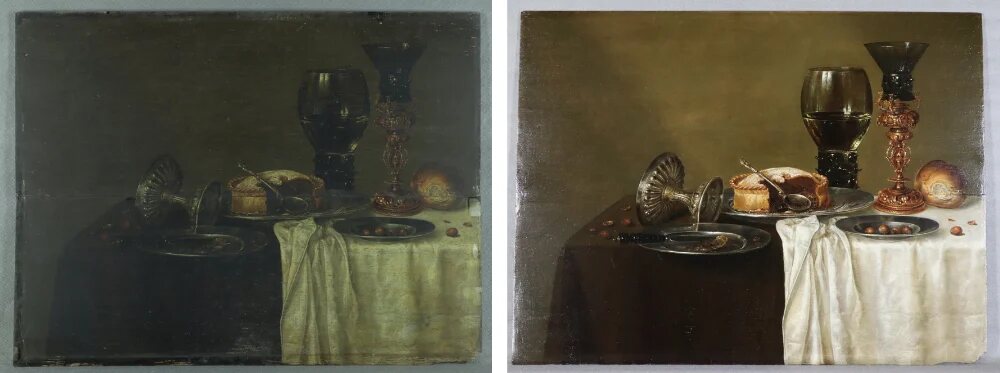
In 2022, a restoration project by the National Trust of Australia led to a remarkable art-historical discovery. A seemingly unremarkable and heavily soiled still life, which had been in storage for decades at the Woodford Academy in New South Wales, was revealed after conservation research to be a seventeenth-century Dutch painting (Figure 1).1 During cleaning, two microscopic signatures emerged on the blade of the knife (Figure 2), after which the work could be attributed to Gerret Willemsz Heda (1625-1649), son of the Haarlem still-life painter Willem Claesz Heda (1594-1680). Specialists suggest that it may be a work jointly produced by father and son, as the painting is dated to around 1640, a time when Gerret was not yet officially registered as an apprentice in his father's workshop. The work displays a conventional Haarlem still-life composition in the tradition of the 'monochrome banketje' (further explanation on p. 5). It is precisely this conventional visual language that makes the find relevant for research into workshop practice and authorship. This discovery sheds new light on questions surrounding workshop practice, authorship, and the transmission of painterly principles within a family circle.
Figure 1: Still Life before treatment (left) and after treatment (right). Photo: National Trust of Australia, April 2022.
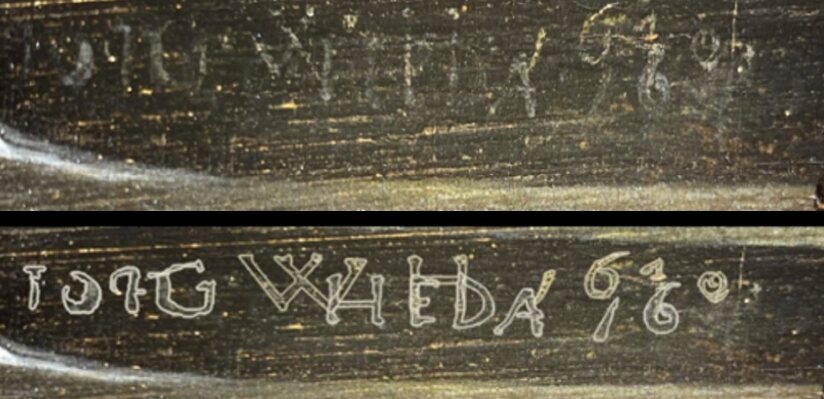
Figure 2: The inscription as found on the knife blade (top) and interpreted (bottom). Photo: National Trust of Australia, April 2022.
The problem of attribution and stylistic demarcation between Willem and his son aligns with a broader, well-documented phenomenon in early modern painting. The organisation of the workshop as a family production centre is central, in which style, composition, and motifs are systematically transmitted and reproduced. This research examines the extent to which the stylistic proximity between Willem and Gerret can be explained by shared workshop practice. The very difficulty of strictly separating father and son is intended to demonstrate that workshop practices did not primarily function around individual artworks, but around reproducible visual formulas. The family workshop is conceived as an artistic production model in which repetition is functional within a market-oriented context. Vroom already noted in his 1945 doctoral thesis that the oeuvres of Willem and Gerret are difficult to distinguish due to Gerret's close compositional adherence to his father.2 For Vroom, this is primarily a problem of connoisseurship: Which painting is by whom? Distinguishing individual hands within a family workshop requires a methodological approach that combines stylistic analysis with technical and contextual evidence. Extensive documentation on the Brueghel dynasty has shown that attribution cannot rest on a single criterion, but must be based on a combination of visual, material, and historical data.3 Workshop contexts often reveal that compositions were transmitted and reproduced with minimal variations and without significant structural changes, which points to the use of fixed schemes or models.4 Furthermore, this analysis requires historical contextualisation. Archival sources, such as guild registrations, confirm the presence of apprentices and the structure of the workshop. This information is essential, as it explains the stylistic similarities not only visually but also institutionally. The historiographical framework in which this study is positioned is largely shaped by three influential approaches. Firstly, in *The Art of Describing*, Svetlana Alpers characterised Dutch painting as a culture of visual registration, in which the world is not so much narrated as described.5 Although this approach has liberated the still life from a purely symbolic interpretation, it remains largely focused on epistemology and representation. It raises questions about what knowledge is, how we arrive at reliable knowledge, and the degree of certainty we can have about our beliefs concerning still lifes in the seventeenth-century Dutch Republic. In this context, Montias shifts the focus to the economic structures of art production, emphasising that artists in the Dutch Republic operated within a market-driven system of supply and demand.6 This economic contextualisation opens up the possibility of considering paintings not only as images but also as products of economic structures. Julie Berger Hochstrasser builds on this in her study of still life and commerce, where a connection is made between the depicted objects and the emerging consumer culture.7 According to her, paintings should be understood as visual manifestations of global trade networks. Although theorists of the time, such as Karel van Mander and Samuel van Hoogstraeten, often disparagingly regarded still life as a genre for "weak spirits," in practice there was an enormous commercial demand for these works.8 Although the Hedas hold a prominent position in the history of seventeenth-century Dutch still life, it is remarkable that systematic art-historical research into their workshop practice is largely absent. A significant portion of the existing literature is dated and primarily focused on stylistic attribution rather than on questions of collective production, familial knowledge transfer, and market-oriented repetition. This research positions itself within this lacuna and aims to provide an initial impetus for a broader re-evaluation of the family workshop. It will be demonstrated to what extent the oeuvre of the son, Gerret, can be understood as a continuation, simplification, or transformation of the painterly and iconographic principles of his father, Heda. Although accurately dating 17th-century works is often a challenge, the year 1642 provides a clear chronological demarcation for this study. On 7 July 1642, Willem officially presented his son Gerret as an apprentice to the Guild of Saint Luke.9 From that moment, we see a parallel production in which Gerret began to develop his own hand within his father's still-life tradition. Due to the relatively small scale of this study, the focus across the oeuvre is on a select number of leading paintings from around the time of Gerret's guild registration. The research thus most closely approximates a workshop practice in which father and son could officially work together for the first time. A limitation of this research is that it focuses on a small selection of paintings from the complete oeuvre of the Hedas. Although the analysis provides clear indications of a shared visual language within the family workshop, it cannot be ruled out that other works may show additional or divergent patterns. Future research can build on this and investigate the entire oeuvre of the Hedas. This study therefore primarily aims to provide an initial impetus for further research into the family workshop of the Hedas.
The Hedas and the Guild of Saint Luke
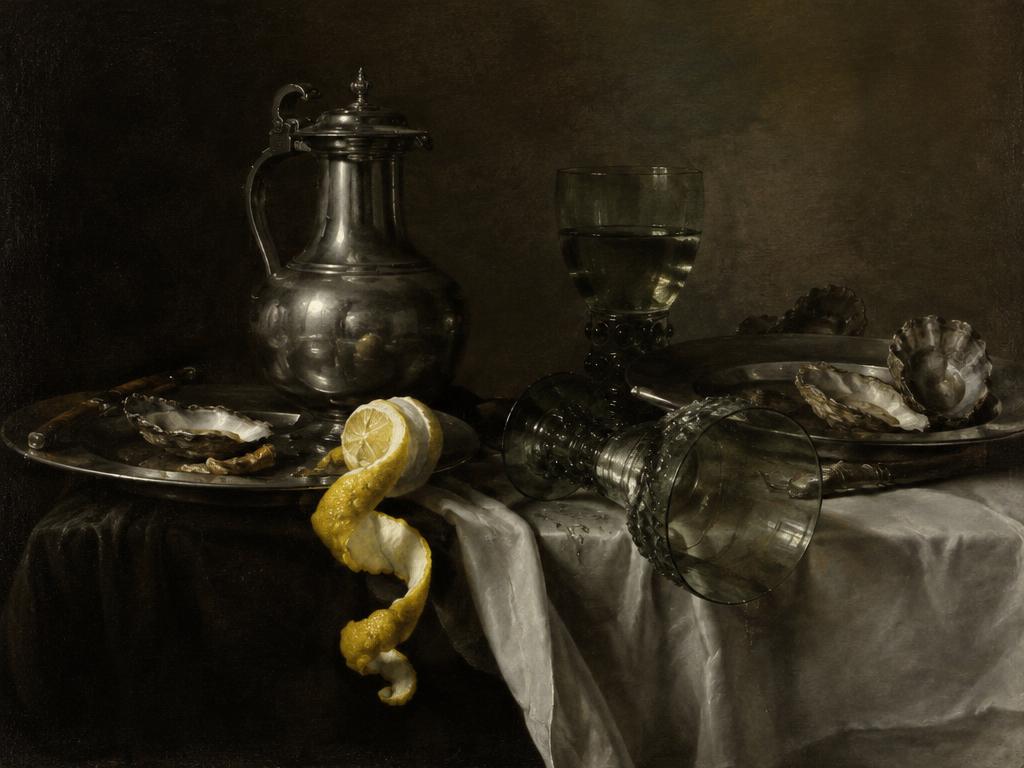
Willem Claesz Heda, born in Haarlem in 1594, is among the most important representatives of the Haarlem still life in the seventeenth century.10 His name is particularly associated with the so-called 'monochrome banketje', a subtype of still life characterised by a limited colour palette, refined treatment of light, and subtle material differentiation. In contrast to the exuberant 'pronkstillevens' of later generations, Heda's work is characterised by a restrained compositional logic in which glasses, metal objects, tableware, and leftover food are placed in a precarious balance. Figure 3 illustrates these characteristics. A subtle balance between glassware, silver, and food remnants demonstrates not only Heda's attention to descriptive accuracy, but above all his exceptional command of reflection, material rendering, and spatial arrangement. It was precisely these formal qualities that made Heda an influential figure in Haarlem painting. His paintings were well suited to the open art market of the Dutch Republic, where still lifes were widely marketable and not necessarily produced on commission.11 These market conditions form an important context for understanding Heda's workshop practice. When successful compositions proved economically profitable, repetition was not only artistically but also commercially logical.
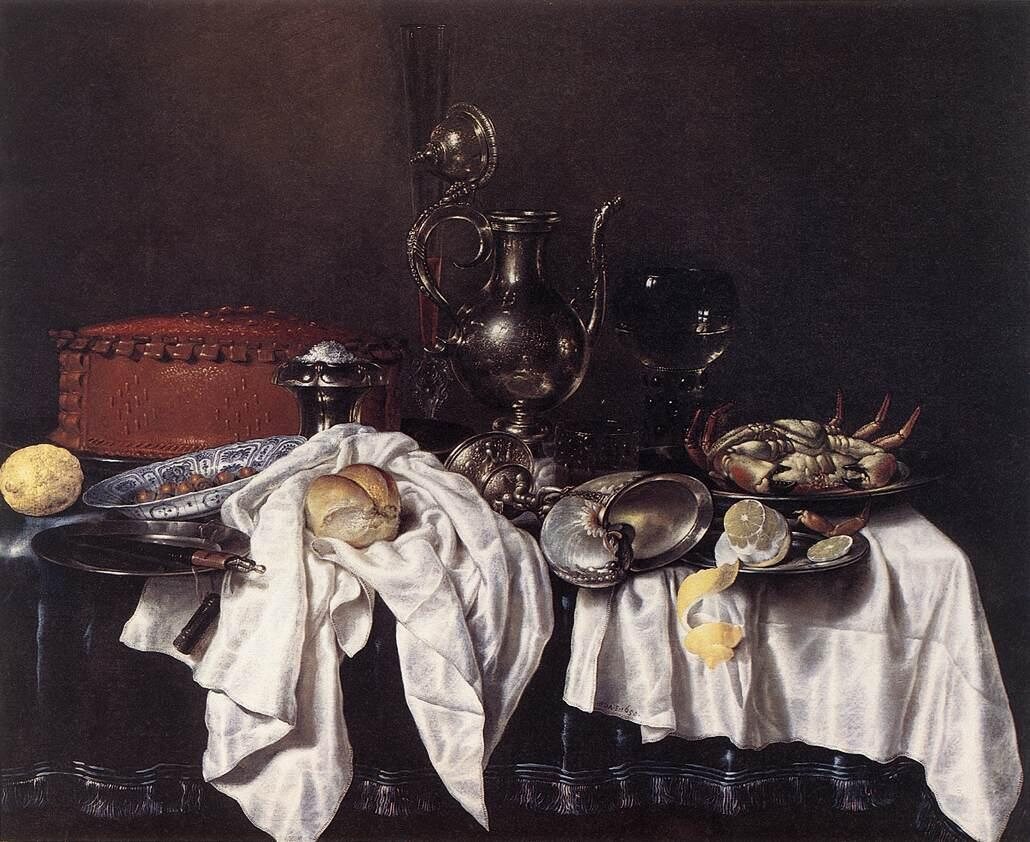
Figure 3: Willem Claesz Heda (1594-1680), Still Life with Pie, Silver Ewer and Crab, 1658. Oil on canvas, 103 x 123 cm. Frans Hals Museum, Haarlem.
Willem's professional activities must be understood within the institutional context of the Haarlem Guild of Saint Luke. Heda was a member of this guild from 1631 and held a board position from 1637.12 In the early modern Dutch Republic, the workshop functioned not only as a place for artistic training but also as an economic production space. Professional recognition within the Haarlem art world provided the opportunity to train apprentices. Apprentices usually began with preparatory tasks, such as grinding pigments and preparing materials.13 As apprentices developed more experience and technical skill, they were gradually involved in the practical execution of paintings. These activities included 'doodverven' (dead-colouring), in which an initial underpainting was applied to establish composition, forms, and tonality. 'Pleumeeren' was also a part of this process, involving the working out of refined details, light reflections, and subtle surface effects.14 Figure 3 can be considered a representative example of the visual and technical repertoire that Willem developed throughout his career and which could be studied and adopted by apprentices. Although there is no direct evidence that apprentices collaborated on the execution of this specific painting, the exceptional attention to recurring object types and painterly effects makes visible what knowledge and skills were transferred within the workshop. The guild archives show that training was highly regulated, but at the same time allowed for familial continuity.15 More favourable conditions applied to the sons of masters than to external apprentices, thus institutionally facilitating transmission within families. Financially, for instance, it was advantageous because children of guild members did not have to pay registration fees, whereas outsiders owed twelve stuivers per year.16 An average day's wage in the seventeenth-century Dutch Republic. Sons of masters often also enjoyed a shortened apprenticeship. The guild regulations stipulated that the training should last a minimum of three years, but in practice this could extend to more than seven years before one achieved the status of master.17 In Gerret's case, his first independent painting was created in the very year of his admission to the guild. Gerret's guild registration marks an important institutional moment, but does not necessarily signify the beginning of his artistic activity. As Vroom notes, there are indications that Gerret was already active in the workshop around 1637, before his formal registration.18 This early involvement is art-historically relevant because it problematises the distinction between training and professional production. Since Gerret was already collaborating on paintings before 1642, his position should not be understood solely from the perspective of a formally registered apprentice, but within a broader context of familial knowledge transfer in which technical skills and painterly principles were gradually learned. The opportunities for enrolling apprentices confirm that Willem's workshop was a professional and respected institution where training was conducted according to the strict economic and qualitative rules of the guild.
The Individual Hand within the Family Workshop
Within seventeenth-century family workshops, repetition functioned as an essential production mechanism. Similar practices surrounding family workshops are extensively documented, such as that of Pieter Bruegel the Elder and his son Pieter Brueghel the Younger. Christina Currie and Dominique Allart have demonstrated that compositions were systematically reproduced and varied, with underlying compositional schemes being transmitted.19 These examples make it clear that visual continuity was not an exception, but a fundamental part of workshop production. Differences in brushwork, paint application, and detailing can provide clues to different hands within a single workshop. Such technical differences were often more consistent than iconographic variations.20 For instance, nuances in the treatment of light, reflections on metal objects, or the finishing of surfaces can serve as distinguishing features. In the case of still lifes, where compositions are often similar, this technical analysis carries particular weight. Following X-ray examination, for example, it has been shown that Gerret's signatures were deliberately altered to that of his father (Figure 4).21 This suggests a close adherence to his father's visual language. The strong stylistic similarities between father and son indicate a successful transfer of technical painting knowledge. The affinity is so great that for a long time art historians struggled to convincingly attribute certain works to either father or son. Only through the use of modern technical investigation, including X-ray analysis, could some attributions be examined more closely. The technical findings render this older attribution problematic, meaning the label at the bottom of Figure 4 can, in any case, be removed.
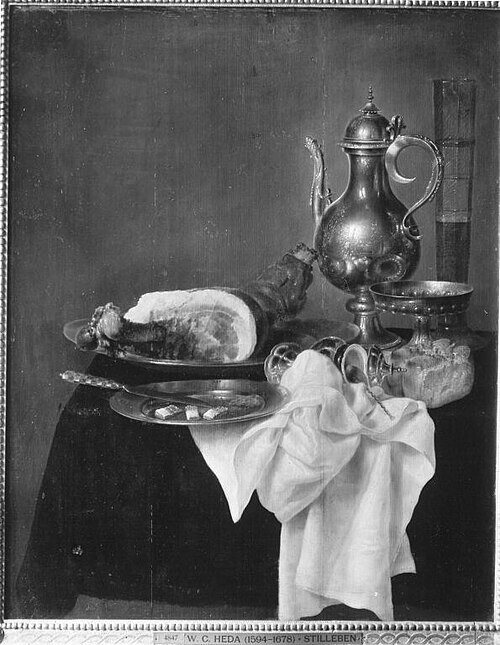
Figure 4: Gerret Claesz Heda (1625-1649), Still Life with Silver Service and Ham, circa 1644-1649. Oil on panel, 78 x 63 cm. Bavarian State Painting Collections, Munich.
Figure 5 provides an example of collaboration between father and son before Gerret's official guild registration. This work bears the signature of the younger Heda, despite being painted in 1637. It shows that Gerret was already functioning as an unofficial collaborator in the workshop at that time, replicating his father's compositions. Although Gerret initially assimilated his father's style to a great extent, he eventually developed his own hand within the workshop practice. A unique characteristic of Gerret is his treatment of white tablecloths, as seen in Figure 4. He painted these in broad, plastic folds that hang down over the edge of the table, a style typified as a "solidified waterfall".22 He visibly specialised in capturing the endless nuances of light in these white tones. This seems to have received much less attention in the jointly produced composition (Figure 5). In his research on St. Luke's Guild Still Lifes, Gregory emphasises that Gerret was technically more objective and assured in his rendering of materials, but that his work remained of a smaller spiritual stature than the atmospheric and monumental masterpieces of his father.23 In doing so, he introduces a hierarchical model of value that is difficult to test empirically. The persistent problems in attributing works to either father or son suggest, on the contrary, that the stylistic distance between the two painters was smaller than such qualitative judgements would imply.
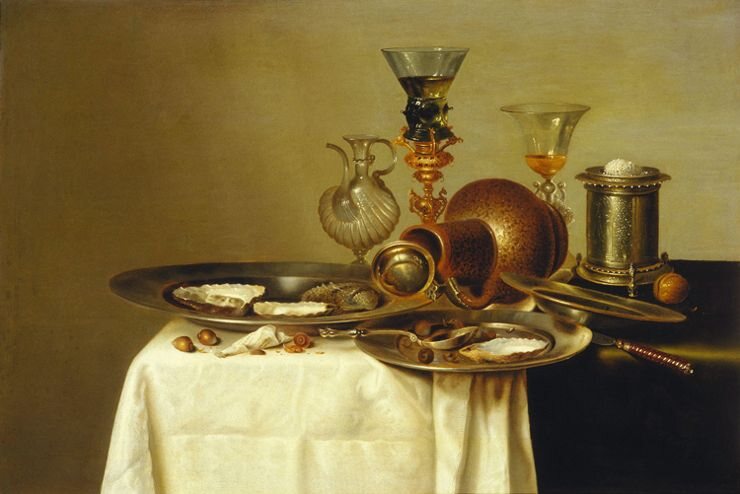
Figure 5: Willem Claesz Heda (1594-1680) & Gerret Willemsz Heda. Still Life with Drinking Glasses, a Recumbent Stoneware Jug, Dishes with Oysters and a Salt Cellar, 1637. Oil on panel, 49.9 x 64.2 cm. Collection Richard Green Fine Paintings, Lausanne, Switzerland.
Identifying individual artistic hands within a family workshop remains methodologically problematic. Although stylistic analysis offers tools for this purpose, it has clear limitations when compositions, motifs, and technical painting procedures are largely shared. This problem becomes even more acute with still lifes, as the genre itself is heavily dependent on the controlled repetition of object types, compositional structures, and material effects. An overturned roemer, a nautilus cup, or a silver dish function not merely as iconographic motifs, but also as workshop-specific visual formulas. Therefore, one must be cautious with an overly rigid search for individual authorship. In this case, the context of production is historically more significant than individual attribution.
Commercial Workshop Practice
In the seventeenth century, the Dutch economy and culture experienced unprecedented growth and prosperity, largely driven by vigorous international trade conducted by institutions such as the Dutch East India Company (VOC) and the West India Company (WIC). Among the notable artistic innovations of this era was the rise of the still life, a genre that showcased wealth and luxury.24 Still lifes, with their intricate depictions of lavish goods such as exotic fruits, luxurious textiles, and imported ceramics, can be seen as reflections of the wealth flowing into the Netherlands.25 The Hedas produced paintings primarily for the open market, a market economy in which recognisable genres and reproducible visual types were economically attractive.26 “The paucity of pictures by William Heda in the Haarlem documents may have resulted from the fact that many of his large paintings were sold to Amsterdam collectors.”27 This quote shows that inventory research has demonstrated that the vast majority of their paintings circulated outside Haarlem. Biesboer notes in this regard that the small number of mentions of Heda's paintings in Haarlem documents is related to the fact that larger works were sold elsewhere, particularly to Amsterdam collectors.28 This observation is relevant because in the seventeenth century, Amsterdam grew to become the economic centre of the Dutch Republic and one of the most important trading and collecting centres in Europe. The presence of Heda's paintings in Amsterdam collections therefore points to a market with considerable collecting potential.
In the case of Pieter Brueghel the Younger, it has been demonstrated that the commercial value of the family name was actively exploited within workshop production.29 With the Hedas, this is demonstrable, for example, through the signature alteration on Figure 4. Because both father and son signed a significant portion of their oeuvre with the family name “Heda”, the attribution of certain paintings remains a subject of art-historical research to this day.30 It is plausible that Gerret's use of the family name not only had an identifying function but was also commercially advantageous in an art market where the name of Willem Claesz Heda already enjoyed considerable prestige. The association with an established painter's name offered significant added value in the appreciation and trade of their works. The signature thus functioned not only as a mark of authorship but also as an instrument of artistic legitimation and commercial positioning. To meet the growing demand, the Hedas developed efficient methods based on the use of stock motifs and compositional templates.31 Stock motifs refer to specific objects or combinations of objects that are used repetitively in different paintings. These motifs functioned as an artist's visual calling card and offered the buyer a recognisable aesthetic element. Examples of this in the Hedas' oeuvre include the overturned silver tazza, the roemer, and the artfully peeled lemon (Figures 1, 3). Compositional templates also refer to the standardised compositional frameworks that served as the foundation for the construction of the image. Instead of designing a completely new arrangement for each work, the workshop used tried-and-tested schemes that could be repeated with minimal variations. The Hedas distinguish themselves in this respect by their preference for the pyramid composition, where the visual mass was shifted to one side of the panel.32 By adhering to a limited arsenal of objects and compositions, the workshop created a strong visual identity that made the name "Heda" a quality brand on the art market.33 The overviews in Figure 6 show that repetition within the Hedas' oeuvre was not an incidental phenomenon but a structural feature of their production. The categorical division of Willem's known oeuvre shows that his production was heavily concentrated around a limited number of recurring compositional types. More than half of the registered paintings belong to the category “meal with one main dish”, which indicates that repetition was not a marginal phenomenon, but a structural principle within his production. The concentration within Gerret's oeuvre is even stronger. Of the thirty known paintings, twenty-three belong to the same main group. This distribution suggests not a broadening of the repertoire, but rather a further concentration on already established visual formulas. The workshop constituted an economically efficient model for artistic continuity from father to son.
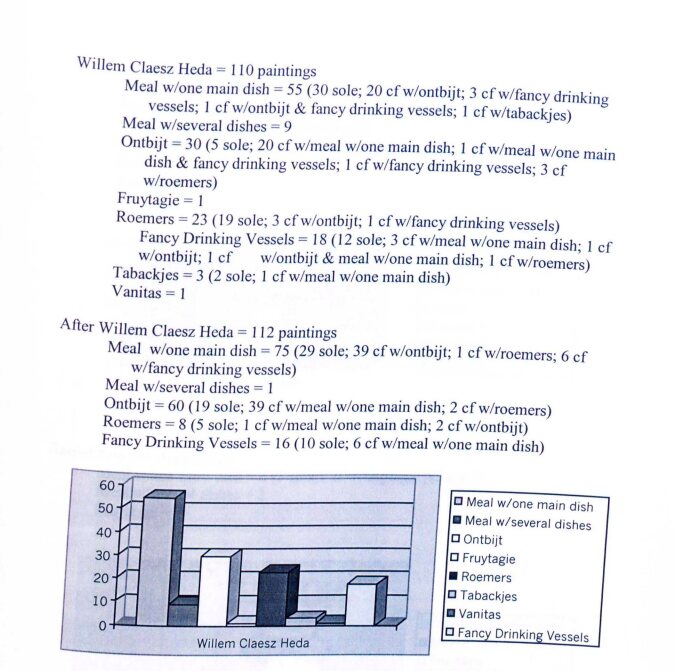
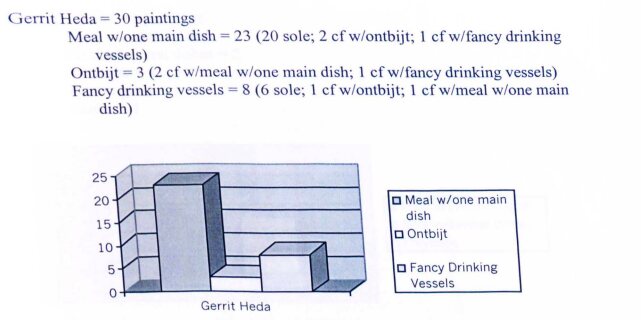
Figure 6: Categorised overview of representations in paintings within the Oeuvre of Willem Claesz Heda & Gerret Willemsz Heda.34
Conclusion
This research has demonstrated that the oeuvre of Gerret Willemsz Heda should primarily be understood as a continuation of the painterly and iconographic principles that Willem Claesz Heda developed within the Haarlem still-life tradition. The analysis of the workshop context, the stylistic similarities between father and son, and the repetition of compositions show that Gerret operated within an already established visual language. The recurrent use of identical objects, similar compositional schemes, and corresponding technical solutions point to a direct transfer of knowledge within the family workshop. The stylistic proximity between the two oeuvres is therefore not only a problem of attribution but also an indication of a production practice in which continuity was central. The institutional context of the Haarlem Guild of Saint Luke supports this interpretation. Willem held a prominent position within the guild and trained apprentices in a professionally organised workshop environment. Gerret's registration as an apprentice in 1642 does not necessarily mark the beginning of his training. The evidence that he was already active in the workshop earlier makes it clear that the transfer of technical painting knowledge took place over a longer period. The workshop functioned as an environment in which existing visual formulas were studied, reproduced, and further developed. The analysis of the paintings shows that Gerret largely adopted his father's compositional principles. Both the joint composition from 1637 and Gerret's later still lifes show a strong dependence on existing Heda formulas. The return of the same object configurations, the preference for similar pyramid compositions, and the continuous attention to reflections and material rendering indicate a conscious continuation of the visual language. At the same time, certain formal characteristics show that Gerret was not merely copying. In particular, his treatment of white tablecloths and his refined attention to the rendering of fabric suggest a limited stylistic development within the existing tradition. That Gerret's oeuvre can only to a limited extent be seen as a simplification of Willem's painting is evident from the persistent problems surrounding the attribution of works to father and son. The need for technical investigation to be able to convincingly distinguish certain paintings underscores the high degree of stylistic agreement between the two oeuvres. The differences are present, but remain subordinate to the structural similarities. The commercial context provides a second important explanation for this continuity. The Hedas produced largely for an open market that extended beyond Haarlem. The presence of their paintings in Amsterdam collections shows that their work circulated within an extensive trade network. Within such a market, recognisability offered an economic advantage. The repetition of successful compositions, objects, and signature practices contributed to the formation of the Heda name as a quality brand. The quantitative distribution of the oeuvre supports this interpretation of the workshop as a system of controlled repetition. Within Gerret's oeuvre, there is no fundamental break or independent stylistic course. However, within this continuity, limited transformations are visible in the execution of specific formal elements. Gerret's main contribution therefore lies not in developing a new type of still life, but in continuing, refining, and commercially exploiting an already successful visual formula. This conclusion also has broader implications for art-historical research on the Hedas. The results show that the question of individual authorship tells only part of the story. At least as important is the role of the family workshop as a place of knowledge transfer, stylistic continuity, and market-oriented production. The family workshop thus appears not as an incidental context for individual production, but as a fundamental mechanism behind the creation, dissemination, and continuity of the seventeenth-century Dutch still life.
Bibliography
Alpers, Svetlana. ‘The Art of Describing: Dutch Art in the Seventeenth Century.’ University of Chicago Press, (1984).
Berger Hochstrasser, Julie. ‘Still Life and Trade in the Dutch Golden Age’. Yale University Press, New Haven & London, (2007).
Biesboer, Pieter. ‘Netherlandish inventories I: Collections of Paintings in Haarlem 1572–1745’. Getty Research Institute, (2001).
Currie, Christina & Dominique Allart. ‘The Brueghel Phenomenon: Paintings by Pieter Bruegel the Elder and Pieter Brueghel the Younger’. Vol. 1, Royal Institute for Cultural Heritage, Brussels, (2012).
Gregory V, Henry Duval. ‘Haarlem Tabletop Still-Life Painting, 1610-1660: A Study of Relationships Between Form and Meaning’. University of Maryland, (2003).
Miedema, Hessel. ‘De archiefbescheiden van het St. Lucasgilde te Haarlem: 1497–1798'. Vol. 2, Alphen aan den Rijn, (1980).
Montias, John Michael. ‘Art at auction in 17th Century Amsterdam’. Amsterdam University Press, (2002).
National Trust (NSW), ‘Discovery of a Dutch Master’. Australia, 17 April 2022.
Vroom, N.R.A. ‘De schilders van het monochrome banketje’. Uitgevers-maatschappij Kosmos, Amsterdam, (1945).