

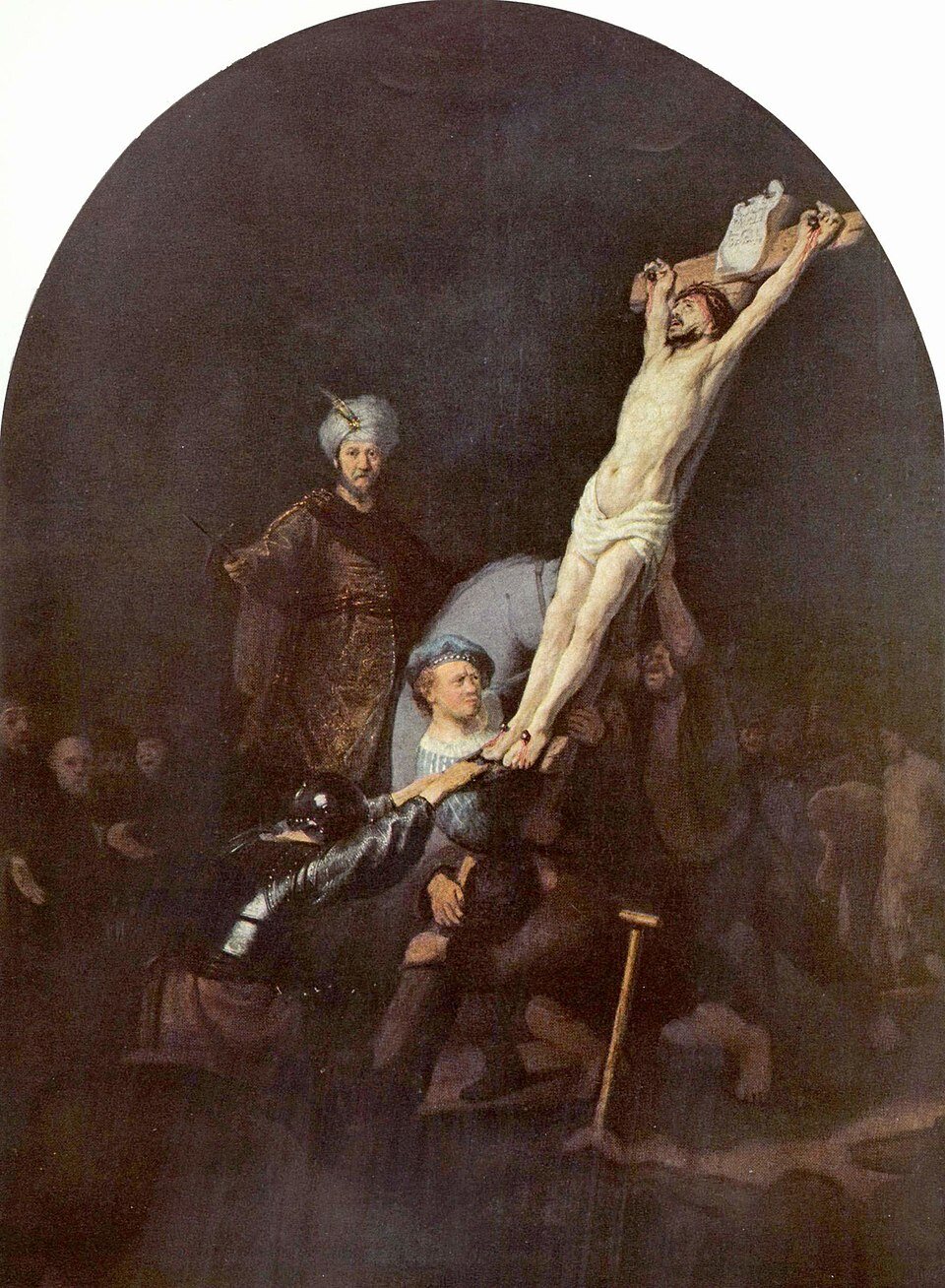
Rembrandt van Rijn
Title The Raising of the Cross
Date 1633
Materials/Technique Oil on panel (oak)
Dimensions 95.7 x 72.2 cm (without frame)
Owner Alte Pinakothek, Munich. Coll. Bayerische Staatsgemäldesammlungen.
Inventory no.: 394
Catalogue no.: The Rembrandt Database, cat. no. A 69
Location In storage
Condition Circa 1750–1760, the works from the Passion series, including The Raising of the Cross, were treated to make them suitable for the collection of the Electors of the Palatinate. Thick layers of varnish were applied at that time, which have yellowed considerably over the centuries. The most drastic intervention was the transfer of the original canvas to a wooden panel by the restorer Brinckmann. It was believed at the time that a wooden support was more stable and better suited for presentation in the Elector's gallery in Düsseldorf.
Restorers from the Bayerische Staatsgemäldesammlungen attempted to stabilise or thin the yellowed varnish layers in the 1950s and 1970s. This made the typical light effect (chiaroscuro) on the figure of Christ more visible again. The composition is clearly legible and the paint adhesion is stable. The finer details in the light around the dove (the Holy Spirit) and the apostles at the bottom are still in good condition. There is some slight surface abrasion, particularly in the dark areas. This is often the result of over-enthusiastic cleaning in previous centuries, during which Rembrandt's extremely thin glazing layers have been partially worn away. The painting is structurally sound; there are no signs of active flaking paint or severe deformation of the support.
Signature & marks Not applicable.
Provenance
Since 1633 in the possession of Prince Frederick Henry of Orange, presumably hanging in the gallery of the Oude Hof on Noordeinde, The Hague.
20 March 1668, in the inventory of Amalia of Solms-Braunfels, widow of Frederick Henry, at the court on Noordeinde.
After her death in 1675, it is assumed that the entire Passion series passed to her grandson, Prince William III, later King of England.
1696, Collection of Johann Wilhelm, Elector of the Palatinate, based in Düsseldorf (reigned 1690–1716).
1719, moved from Düsseldorf to Mannheim prior to the bombardment by the Prussian army in 1758, after which the Passion series returned to Düsseldorf in 1764. Upon the approach of French troops under Bernadotte in 1794, the paintings were moved to Glückstadt and returned to Düsseldorf about ten years later.
Transferred to Kirchheimbolanden before the Duchy of Berg (including Düsseldorf) was ceded to France in 1805.
Since 1806 in Munich, Alte Pinakothek, Munich.
Keyword(s) object Painting, history painting
Keyword(s) image Biblical: New Testament, Passion of Christ, Raising of the Cross
Iconclass 73D, 73D54
Comments This painting is part of Rembrandt's Passion series, made for Frederick Henry and Amalia of Solms. The commission was also executed in consultation with the secretary Christiaan Huygens. The painting displays a composition organised around a dominant diagonal movement and is thematically linked to The Descent from the Cross (A65) and other works in the Passion series, namely: The Descent from the Cross, The Entombment, The Resurrection and The Ascension. Preparatory studies in the form of drawings indicate that Rembrandt was already engaged with this subject around 1628, which points to a long conceptual development (Corpus Rembrandt II). The composition shows influences from graphic art, including that of Albrecht Altdorfer, and reflects Rembrandt's engagement with existing pictorial traditions. For the provenance, the catalogue refers to A65, which underscores the close connection between the two works.
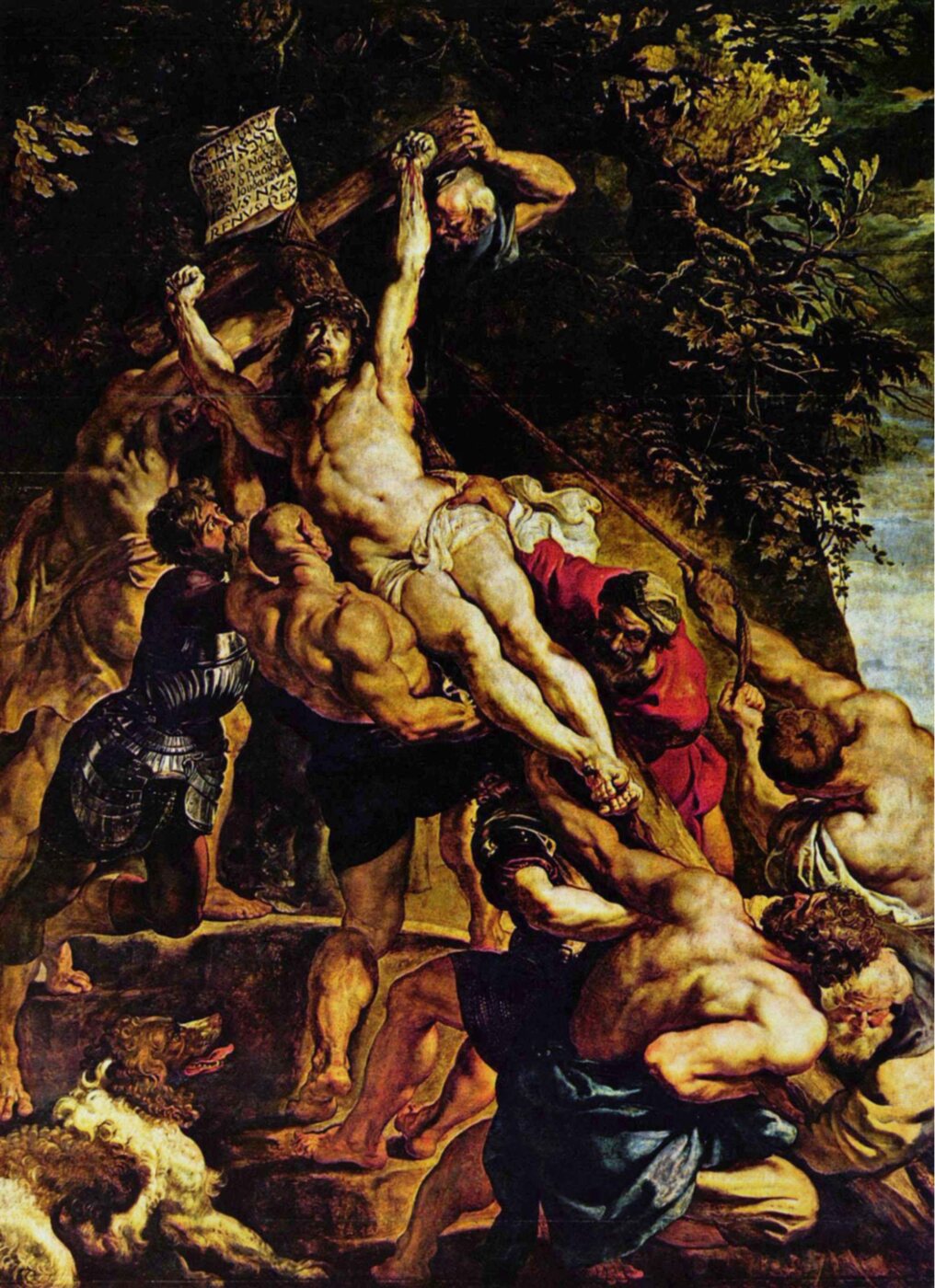
Peter Paul Rubens
Title The Raising of the Cross
Date 1610-1611
Materials/Technique Oil on panel (oak)
Dimensions 460 x 430 cm (unframed, central panel)
Owner Coll. Cathedral of Our Lady, Antwerp, Belgium
Inventory no.: Not applicable
Catalogue no.: Corpus Rubenianum VI, Ludwig Burchard cat. no. V17
Location On display, on the high altar of the Cathedral of Our Lady, Antwerp
Condition After being looted by French troops (1794-1815), the work was subjected to cleaning and consolidation in Paris to prepare it for exhibition at the Musée Napoléon. After the Second World War, a very extensive restoration was carried out between 1945-1953 by the Royal Institute for Cultural Heritage (KIK-IRPA) in Brussels. The central panel and the side wings were completely cleaned, the varnish layer was renewed and the wooden supports were stabilised. In the context of the Rubens Year (1977), the work underwent a major cleaning and conservation treatment. The work is currently continuously monitored by conservators from the cathedral and the Royal Museum of Fine Arts Antwerp (KMSKA). The painting is currently part of a recent large-scale project called ‘Rubens in Restoration’, in which the restoration work is being carried out on-site in the cathedral. The current condition can be described as stable but delicate.
Signature & marks Not applicable.
Provenance Originally created for the Church of St Walburga, Antwerp 1610–1611. 1794, The painting was taken to Paris by the French occupying forces, which at the time had a major impact on the physical context of the work. After being moved in 1815, it was housed in the Cathedral of Our Lady, Antwerp; kept there ever since.
Keyword(s) object Painting, altarpiece, triptych
Keyword(s) image Biblical: New Testament, Passion of Christ, Raising of the Cross
Iconclass 73D, 73D54, 73D551
Comments This monumental altarpiece forms part of a triptych and was originally created for the Church of St Walburga in Antwerp, before being transferred to the Cathedral of Our Lady. The work is often considered a key piece from Rubens’s early Antwerp period and is seen as a significant moment in his establishment as the leading painter in Antwerp. The composition, characterised by a powerful diagonal structure, was widely disseminated through reproductive prints, notably by Lucas Vorsterman, whereby the work played an important role in the international dissemination of Rubens’s visual language. The Raising of the Cross functions as a counterpart to The Descent from the Cross (1612–1614), also in the Cathedral of Antwerp, thereby creating a thematically and visually coherent altar composition (Corpus Rubenianum VI, Ludwig Burchard).
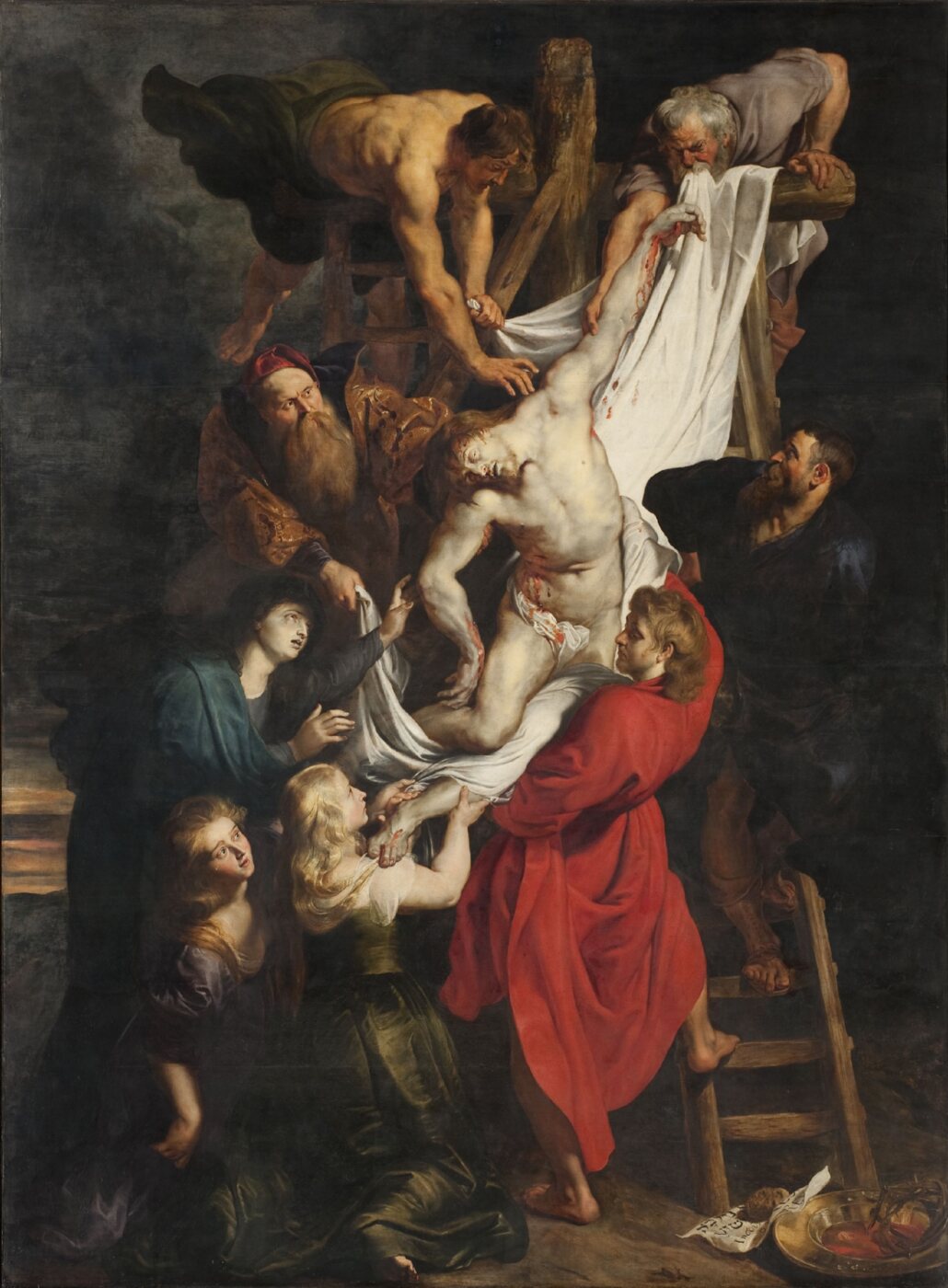
Peter Paul Rubens
Title The Descent from the Cross (central panel)
Date 1612-1614
Materials/Technique Oil on panel
Dimensions 420.5 x 320 cm (unframed, central panel)
Owner Coll. Cathedral of Our Lady, Antwerp, Belgium
Inventory no.: Not applicable
Catalogue no.: Corpus Rubenianum VI, Ludwig Burchard cat. no. V43
Location On display, Cathedral of Our Lady, Antwerp
Condition After being looted by French troops (1794-1815), the work underwent cleaning and consolidation in Paris to prepare it for exhibition in the Musée Napoléon (present-day Louvre). Between 1960 and 1963, a very extensive restoration was carried out by the Royal Institute for Cultural Heritage (KIK-IRPA) in Brussels. This was the most significant restoration. The yellowed varnish and 19th-century overpainting were removed, restoring the brightness of the iconic white shroud. Currently, the painting is part of a recent large-scale project called ‘Rubens in Restoration’, with the restoration work being carried out on-site in the cathedral. The current condition of the painting is very good. The work is strictly monitored for humidity and temperature. ‘Rubens red’, the characteristic red pigment areas, are well-preserved and there are no noticeable damages or defects to the painting.
Signature & marks Not applicable.
Provenance The work was commissioned in 1611 by the archducal guild of the Arquebusiers (a city militia guild) as an altarpiece for their chapel in the Cathedral of Our Lady. The central panel was completed in 1612, and the entire triptych (including the side panels with The Visitation and The Presentation in the Temple) was installed in the cathedral in 1614. During the French Revolution, in 1794, the masterpiece was seized by French revolutionary troops and transferred to the Louvre in Paris. After the fall of Napoleon Bonaparte, the painting was returned to Antwerp in 1815 and reinstalled in the Cathedral of Our Lady.
Keyword(s) object Painting, altarpiece, triptych
Keyword(s) image Biblical: New Testament, Passion of Christ, Descent from the Cross
Iconclass 73D, 73D71
Comments In seventeenth-century sources, the artist is also mentioned as ‘Petrus Paulus Rubens’. In non-Dutch literature, the work itself is known as The Descent from the Cross (English) or La Descente de la Croix (French). The work is also alternatively referred to as the ‘Altarpiece of the Arquebusiers’, the Antwerp civic guard or militia guild. The Descent from the Cross, together with The Raising of the Cross (1610-11) and The Assumption of the Virgin Mary (1626), forms the core of Rubens' masterpieces in Antwerp Cathedral. Due to the wide dissemination of this specific design, numerous early copies exist. A very important engraving was made in 1620 by Lucas Vorsterman, under the direct supervision of Rubens himself, to distribute the work internationally. Additional technical data on the 20th-century restoration can be found in the publications of the KIK-IRPA (Brussels).
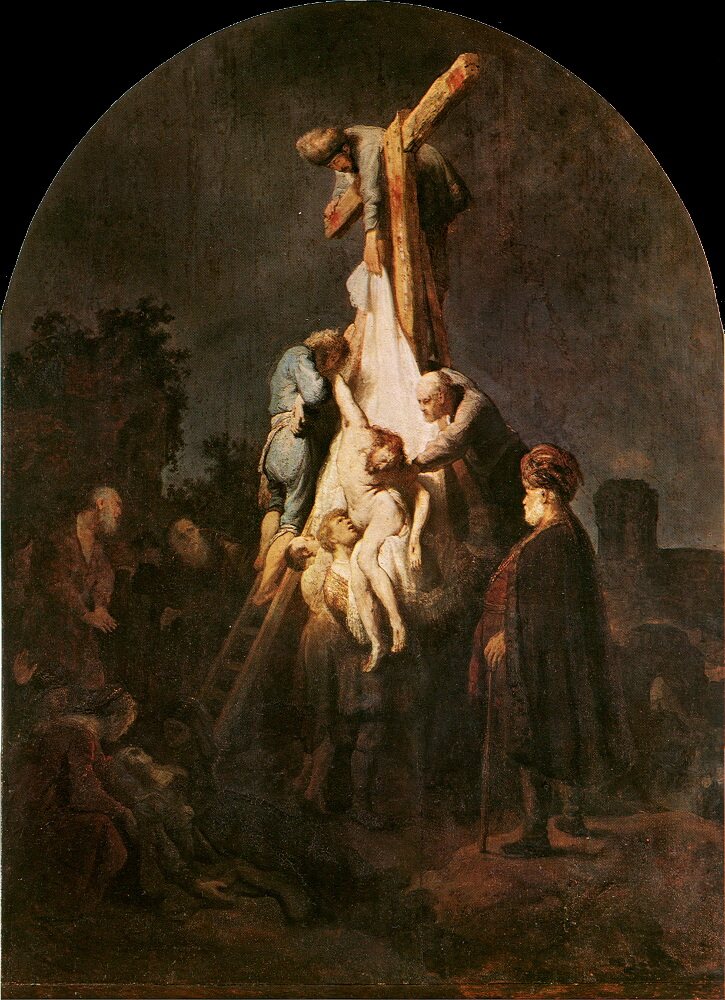
Rembrandt van Rijn
Title The Descent from the Cross
Date 1632-1633
Materials/Technique Oil on panel (cedar wood)
Dimensions 89.2 x 65.0 cm (unframed)
Owner Alte Pinakothek, Munich. Coll. Bayerische Staatsgemäldesammlungen.
Inventory no 395
Catalogue no The Rembrandt Database, cat. no. A 65
Location Depot, Alte Pinakothek, Munich.
Condition The painting has a very dark composition, with lighter tones having yellowed. A restoration was carried out in 1775 by Philipp Brinckmann. The painting is in a moderate to problematic condition. There is paint loss and damage to the surface paint layer. The current state of the work may be related to earlier damage, presumably caused by a disaster that occurred in the eighteenth century and also affected other works from the same context.
Signature & marks Not applicable.
Provenance (Applies to the entire Passion series, from the moment of its creation by Rembrandt for Stadtholder Prince Frederick Henry of Orange)
Since 1633 in the possession of Prince Frederick Henry of Orange, presumably hanging in the gallery of the Oude Hof at the Noordeinde, The Hague
20 March 1668, in the inventory of Amalia of Solms, widow of Frederick Henry, at the court at the Noordeinde.
After her death in 1675, it must be assumed that the complete Passion series passed to her grandson Prince William III, later King of England.
1696, Collection of Johann Wilhelm, Elector Palatine based in Düsseldorf (reigned 1690–1716).
In 1719, moved from Düsseldorf to Mannheim before the bombardment by the Prussian army in 1758, after which the Passion series returned to Düsseldorf in 1764. On the approach of French troops under Bernadotte in 1794, the paintings were moved to Gluckstadt and returned to Düsseldorf approximately ten years later.
Transferred to Kirchheimbolanden before the Duchy of Berg (including Düsseldorf) was ceded to France in 1805.
Since 1806 in Munich, Alte Pinakothek, Munich.
Keyword(s) object Painting; history piece
Keyword(s) image Biblical: New Testament; Passion of Christ; Descent from the Cross
Iconclass; 73D, 73D71
Comments The Descent from the Cross belongs to Rembrandt's early Passion series and is characterised by a complex genesis, as revealed by X-ray examination that brought numerous compositional changes to light (Corpus Rembrandt II). In comparison with The Raising of the Cross (A69), the changes in this work are more radical, indicating a large number of compositional alterations during the creative process. The painting is associated with the court context of Stadtholder Prince Frederick Henry of Orange, although not all circumstances of the commission are fully documented. The composition shows a clear relationship with Rubens’ painting The Descent from the Cross (1612–1614), partly through the circulation of prints, and can be seen as part of a broader artistic dialogue with international models.
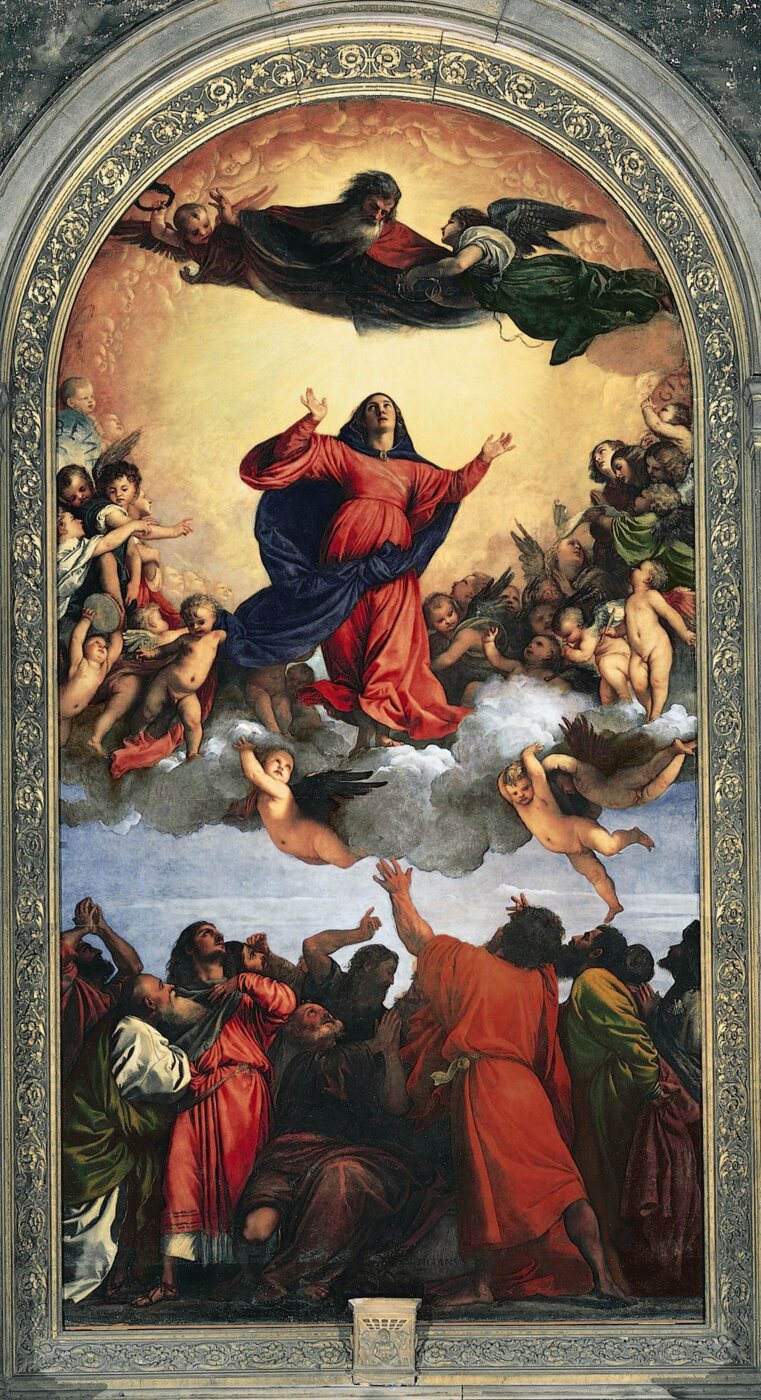
Tiziano Vecellio (Titian)
Title Assumption of the Virgin
Date 1516-1518
Materials/Technique Oil on panel
Dimensions 690 x 360 cm (including frame)
Owner Diocese of Venice, Basilica di Santa Maria Gloriosa dei Frari
Inventory no MAG 200813641
Catalogue no Cat. no. 39
Location On display in the Basilica di Santa Maria Gloriosa dei Frari, Venice, Italy.
Condition During its relocation to the Accademia in 1817, the work was 'refreshed'. By modern standards, this restoration was aggressive. Thick layers of varnish and overpainting were applied to make the work appear newer. In 1974, conservation was undertaken by Leonetto Tintori. This was a necessary restoration focusing on the stabilisation of the paint layers, which had begun to lift from the panel. The most recent and thorough restoration was carried out between 2018–2022 by Giulio Bono & Save Venice. Initially, the work was cleaned. Dark, yellowed layers of varnish and old overpainting were removed, revealing the original, bright colours and the fall of light. The reverse of the panel was treated against insects. The work is now luminous. Modern equipment has been installed to keep the humidity around the high altar constant, which is essential for the preservation of the panel.
Signature & marks Recto, lower right on the frame; ‘TITIANUS’
Provenance
The work was installed on 19 May 1518. In 1817, it was transferred to the Gallerie dell’Accademia in Venice. At the end of the First World War in 1918, the painting returned to its original location above the high altar of the Basilica di Santa Maria Gloriosa dei Frari, Venice, Italy.
Keyword(s) object Painting, altarpiece.
Keyword(s) image Biblical: New Testament; Assumption of the Virgin, Apostles, Mary, God, Basilica di Santa Maria Gloriosa dei Frari
Iconclass 73D, 73E, 73E42, 73E77
Comments This altarpiece, created for the Basilica di Santa Maria Gloriosa dei Frari in Venice, is one of Titian's earliest monumental works and is regarded as a seminal monumental altarpiece within his oeuvre and in Venetian painting. The composition is structured in three registers: the Apostles, Mary, and God the Father. The painting is characterised by a dynamic vertical movement and an intense use of colour. The Italian name for the Assumption is Assunta.
Rembrandt van Rijn
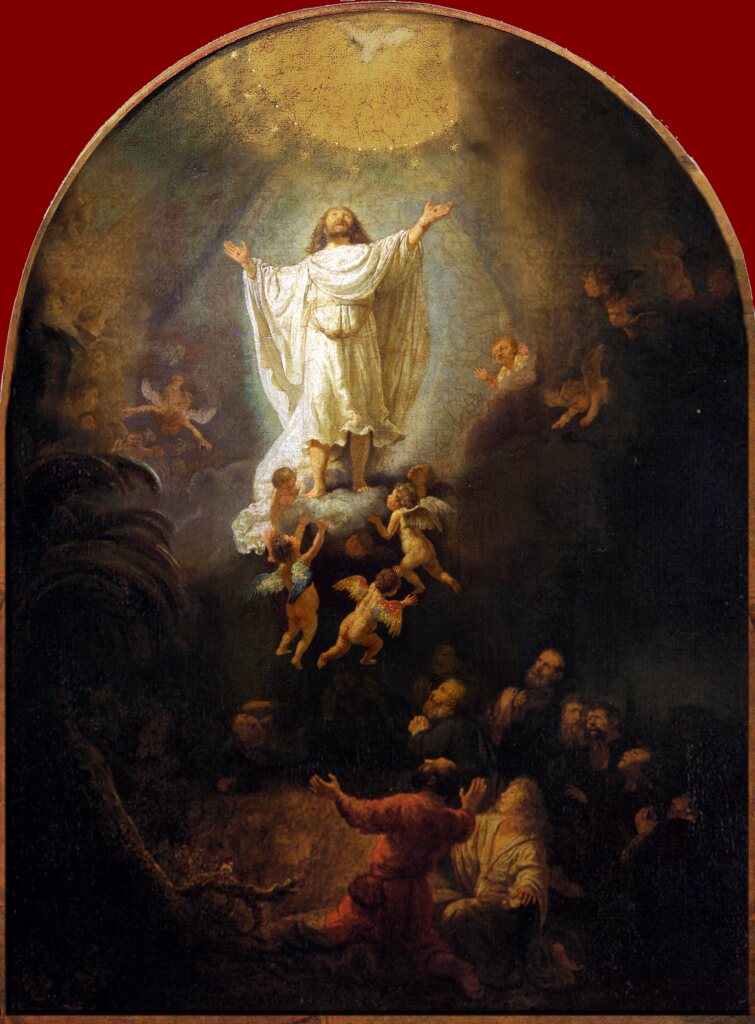
Title The Ascension
Date 1636
Material/Technique Oil on canvas
Dimensions 92.7 x 68.3 cm (without frame)
Owner Alte Pinakothek Museum Munich. Coll. Bayerische Staatsgemäldesammlungen.
Inventory nr 398
Catalogue nr The Rembrandt Database, cat. no. A 118
Location Depot, Alte Pinakothek Museum, Munich.
Condition During this period (c. 1750–1760), the works from the Passion series, including *The Ascension*, were treated to make them suitable for the collection of the Electors of the Palatinate. Thick layers of varnish were applied, which have yellowed significantly over the centuries. In the 1950s and 1970s, restorers from the Bayerische Staatsgemäldesammlungen attempted to stabilise or thin the yellowed varnish layers. This made the typical use of light (chiaroscuro) on the figure of Christ more visible again. The composition is clearly legible and the paint adhesion is stable. The finer details in the light around the dove (the Holy Spirit) and the apostles at the bottom are still in good condition. There is minor surface abrasion, particularly in the dark passages. This is often the result of over-enthusiastic cleaning in previous centuries, during which Rembrandt's extremely thin, glazing paint layers were partially worn away. The painting is structurally sound; there are no signs of active flaking paint or severe distortion of the canvas.
Signature & marks Recto, lower centre right: “R (..)b(..)t f (...)6” of which the R, the b, the t and the final 6 of the date are only partially preserved.
Provenance (Applies to the entire Passion series, from the moment of its creation by Rembrandt for Stadholder Prince Frederick Henry of Orange)
Since 1633 in the possession of Prince Frederick Henry of Orange, presumably hanging in the gallery of the Oude Hof on the Noordeinde, The Hague
20 March 1668, in the inventory of Amalia van Solms, widow of Frederick Henry, at the Hof on the Noordeinde.
After her death in 1675, it is to be assumed that the entire Passion series passed to her grandson Prince William III, later King of England.
1696, Collection of Johann Wilhelm, Elector of the Palatinate, based in Düsseldorf (reigned 1690–1716).
1719, moved from Düsseldorf to Mannheim prior to the bombardment by the Prussian army in 1758, after which the Passion series returned to Düsseldorf in 1764. On the approach of French troops under Bernadotte in 1794, the paintings were moved to Glückstadt and returned to Düsseldorf about ten years later.
Transferred to Kirchheimbolanden before the Duchy of Berg (including Düsseldorf) was ceded to France in 1805.
Since 1806 in Munich, Alte Pinakothek, Munich.
Keyword(s) object painting; history painting
Keyword(s) image Biblical: New Testament, Christ, The Ascension
Iconclass 73D, 73E, 73E42
Comments *The Ascension* is part of Rembrandt's Passion series and thematically connects with earlier depictions such as *The Raising of the Cross* and *The Descent from the Cross*. The work is associated with a commission from the court of Frederick Henry. The composition is characterised by a strong emphasis on vertical movement and the use of light, visually accentuating Christ’s ascension. Within the series, this work represents a later phase in which Rembrandt further developed his approach to religious representations. The coherence with the other Passion paintings indicates a programmatic design, intended for a specific representative context (Corpus Rembrandt III). Within the Passion series, this work is distinguished by being executed on canvas, whereas the other paintings are on panel.